Loading...
Please wait while we load your content...
Please wait while we load your content...
We have listed the number of hot spring sources by type for the 487 sources in Gifu Prefecture in Table 4, and a graph showing the number of sources by type in descending order in Figure 6 (as of the end of March 2004).
Table 4 Breakdown of 487 hot springs in Gifu Prefecture by type
| Type of Hot Spring | Number of Sources | % |
|---|---|---|
| Simple Hot Spring | 124 | 25.5 |
| Alkaline Simple Hot Spring | 43 | 8.8 |
| Simple Carbon Dioxide Spring | 3 | 0.6 |
| Simple Sulfur Spring | 33 | 6.8 |
| Simple Iron Spring | 6 | 1.2 |
| Sodium Chloride Spring (Salt Spring) | 34 | 7.0 |
| Sodium Bicarbonate Spring (Baking Soda Spring) | 96 | 19.7 |
| Calcium Bicarbonate Spring (Bicarbonate Earth Spring) | 7 | 1.4 |
| Sodium Sulfate Spring (Glauber's Salt Spring) | 4 | 0.8 |
| Calcium Chloride Spring | 5 | 1.0 |
| Simple Radioactive Spring | 84 | 17.2 |
| Hot Springs Corresponding to Article 2 of the Hot Springs Act | 28 | 5.7 |
| Unanalyzed | 20 | 4.1 |
| Total | 487 | 100.0 |
Data provided by Mr. Hiroshi Terao, Gifu Prefecture Institute of Health and Environmental Sciences
Figure 6 Breakdown of 487 hot springs in Gifu Prefecture by type
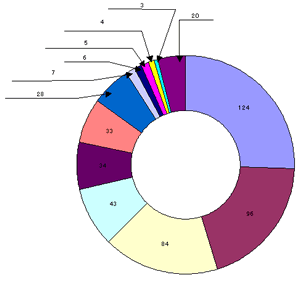
The most common type of hot spring in Gifu Prefecture is the Simple Hot Spring, accounting for about a quarter (25.5%) of the total. This is followed by Sodium Bicarbonate Spring (19.7%), Simple Radioactive Spring (17.2%), and Alkaline Simple Hot Spring (8.8%).
The "Hot Springs Corresponding to Article 2" in the table refers to hot springs that meet the definition of the Hot Springs Act and are recognized as "hot springs" but do not qualify as therapeutic springs.
Compared to the national frequency of hot spring types, the characteristics of hot springs in Gifu Prefecture include:
These are the characteristics that can be noted.