- Part 4 The effects and benefits of hot springs vary by type (spring quality), please explain.
Topics
Gifu's Hot Spring Therapy
I've heard that the effects and benefits of hot springs vary depending on their type (mineral composition). Could you explain this?
Medically recognized therapeutic hot springs are called "therapeutic springs." These springs are broadly classified into the following nine types based on their main components, and each type has specific indications.
- Carbon Dioxide Springs (Carbonated Springs)
-
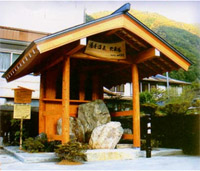
These springs have a high carbon dioxide content and are called "soda springs" because they have a fizzy texture when drunk. The carbon dioxide effect dilates capillaries, warming the body, and is said to be effective for high blood pressure and arteriosclerosis. Drinking it is also effective for gastrointestinal diseases. In Gifu Prefecture, "Yuya Hot Spring" and "Shimojima Hot Spring" are known as carbonated springs.
Yuya Hot Spring Drinking Fountain
- Bicarbonate Springs (Baking Soda Springs, Bicarbonate Earth Springs)
- These springs contain a lot of baking soda, and the alkaline components make the skin smooth. Known as "beauty springs" for their skin-smoothing effects, Gifu Prefecture has several bicarbonate springs, including "Hirayu Hot Spring" and "Nakatsugawa Hot Spring." They are said to be effective for cuts and chronic skin diseases when used for bathing.
- Chloride Springs (Salt Springs)
- These springs contain a lot of salt, providing warmth and preventing chills after bathing, hence called "heat springs." They are said to be effective for muscle and joint pain, bruises, sprains, cold sensitivity, chronic gynecological diseases, menstrual disorders, infertility, and recovery after illness. In Gifu Prefecture, Hashima Hot Spring, Kaizu Hot Spring, and Usuzumi Hot Spring are chloride springs.
- Sulfate Springs (Gypsum Springs, Glauber's Salt Springs, Bitter Springs)
- These springs contain a lot of sulfate ions and have a bitter taste when drunk. Gypsum springs, in particular, are effective for wounds and burns, hence called "wound springs." In Gifu Prefecture, there are few examples, but "Nigorigo Hot Spring" in the Kosaka Hot Spring Village is one of them (Glauber's Salt Spring).
- Sulfur Springs (Simple Sulfur Springs, Hydrogen Sulfide Springs)
- These springs are characterized by the smell of hydrogen sulfide gas and are often found in volcanic areas. Sulfur springs have antibacterial properties, making them effective for skin diseases, and are also recognized for indications such as high blood pressure, arteriosclerosis, muscle pain, and joint pain. However, they can cause skin irritation, so caution is needed. In Gifu Prefecture, Shin-Hotaka Hot Spring and Hirase Hot Spring (Oshirakawa Hot Spring) are sulfur springs.
- Iron Springs (Carbonated Iron Springs, Green Vitriol Springs)
- These springs contain a lot of iron, and although they are transparent when they emerge, the iron reacts with oxygen in the air, producing iron oxide, and gradually turning reddish-brown. In Gifu Prefecture, Nagara River Hot Spring and Furukawa Hot Spring are examples, known for their warming effects and benefits for gynecological diseases.
- Acidic Springs (Alum Springs)
- These springs are strongly acidic and have a stinging sensation on the skin. People with sensitive skin may experience irritation, so rinsing after bathing is necessary. They are effective for chronic skin diseases, but there are no springs of this type in Gifu Prefecture.
- Radioactive Springs (Radium Springs)
-
Known as radium springs, these springs contain trace amounts of radioactivity. It is said that trace radioactivity boosts the body's immunity, and when drunk, it has a diuretic effect, helping to excrete uric acid, hence called "gout springs." In the Tono region of Gifu Prefecture, there are many radium springs, such as Kakino Hot Spring and Byakko Hot Spring, with legends of recovery from injuries and illnesses.
Kakino Hot Spring, Toki City, Gifu Prefecture
- Simple Springs (Simple Springs, Alkaline Simple Springs)
-
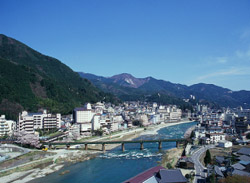
Among therapeutic springs, those with less than 1 gram of dissolved substances per liter are called "simple springs." Those with a pH of 8.5 or higher are called alkaline simple springs. They are colorless, transparent, and have a gentle touch, making them widely used for convalescence after illness, post-surgery recovery, and rehabilitation after fractures or injuries. This is the most common type of spring in Gifu Prefecture, with Gero Hot Spring being one of the "Three Famous Springs of Japan," known nationwide. The Gero Hot Spring Hospital in the hot spring town uses the springs for medical purposes.
Gero Hot Spring, Gero City, Gifu Prefecture